
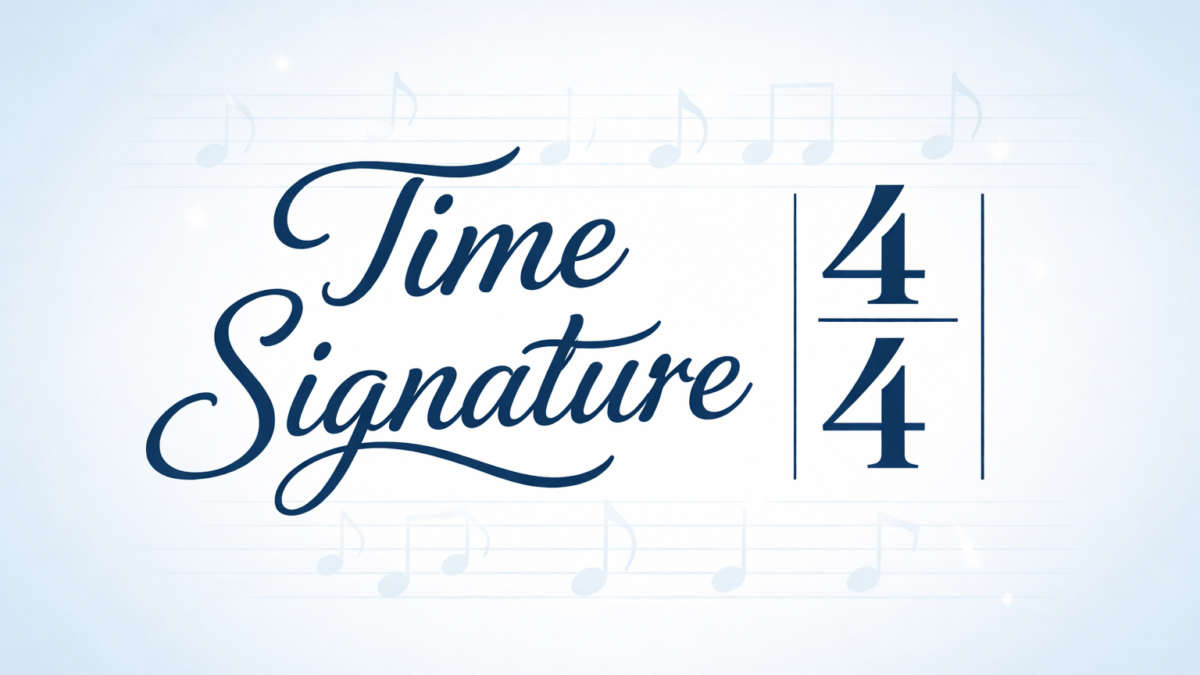
Time Signatures
Time Signature — Notation indicating how many beats occur in each measure and which note value receives one beat
Simple Time — Meter where each beat divides naturally into two equal parts
Compound Time — Meter where each beat divides naturally into three equal parts
Duple Meter — Time signature with two beats per measure
Triple Meter — Time signature with three beats per measure
Quadruple Meter — Time signature with four beats per measure
Simple Duple Time — Two beats per measure with beats divided into two (e.g., 2/4)
Simple Triple Time — Three beats per measure with beats divided into two (e.g., 3/4)
Simple Quadruple Time — Four beats per measure with beats divided into two (e.g., 4/4)
Compound Duple Time — Two beats per measure with beats divided into three (e.g., 6/8)
Compound Triple Time — Three beats per measure with beats divided into three (e.g., 9/8)
Compound Quadruple Time — Four beats per measure with beats divided into three (e.g., 12/8)
Common Time — Alternate symbol for 4/4 time signature
Cut Time (Alla Breve) — Notation for 2/2 time emphasizing half-note beats
Asymmetrical Meter — Time signature with uneven beat groupings (e.g., 5/8, 7/8)
Odd Meter — Any time signature with an odd number of beats or subdivisions
Additive Meter — Meter constructed from grouped subdivisions (e.g., 3+2+3/8)
Complex Meter — Time signature combining multiple beat groupings within one measure
Mixed Meter — Frequent or deliberate changes of time signature between measures
Changing Meter — Explicit alternation of time signatures written into the score
Polymeter — Simultaneous use of different time signatures in different voices
Polyrhythm — Multiple rhythmic groupings occurring simultaneously within the same meter
Cross-Rhythm — Rhythmic pattern contradicting the primary meter’s accent structure
Irrational Time Signature — Time signature using unconventional denominators (e.g., 5/6, 7/12)
Fractional Time Signature — Meter indicating proportional beat relationships rather than fixed note values
Metric Modulation — Technique where a note value in one meter becomes the beat unit of another
Free Time — Absence of a fixed or recurring time signature
Unmetered Music — Music without measurable beats or bars
Ametric Music — Music that deliberately avoids metric organization
Metric Dissonance — Conflict between perceived beat groupings and notated meter
Hemiola — Temporary shift in perceived meter, often two beats replacing three
Hypermeter — Large-scale grouping of measures perceived as higher-level beats
Submetric Pulse — Fast underlying rhythmic subdivision beneath the primary beat
Macro-Meter — Overall large-scale metric framework of a composition
Micro-Meter — Small-scale rhythmic subdivisions operating within a beat
Swing Meter — Interpretive alteration of straight subdivisions into long-short patterns
Tuplet-Based Meter — Meter emphasizing irregular subdivisions such as quintuplets or septuplets
Isorhythm — Repeating rhythmic pattern independent of melodic material
Metric Ostinato — Repeated rhythmic figure reinforcing a specific meter
Metric Ambiguity — Deliberate uncertainty about the perceived meter
Hidden Meter — Meter implied by accents rather than explicitly stated
Metric Phase Shifting — Gradual displacement of rhythmic patterns against the meter